



Nasolabial Folds: Non-Surgical Treatment Options in Lisbon
What causes the lines from your nose to the corners of your mouth, why they appear earlier in some people, and what non-surgical options exist in Lisbon. No outcome guarantees — just the clinical picture.
Nasolabial folds are one of the most common concerns at our clinic — and one of the most misunderstood. Most people assume they are a wrinkle problem. Clinically, they are primarily a volume and structural support problem. That distinction determines which treatment makes sense.
This guide covers, in order: what nasolabial folds are anatomically, what causes them, why they deepen with age (and sometimes much earlier than expected), when treatment is appropriate, what non-surgical options exist in Lisbon, and what realistic expectations look like for each. For filler treatments more broadly, we have a separate guide.
What nasolabial folds are
The nasolabial fold is the crease that runs from the corners of the nose down to the corners of the mouth. It is present from childhood as a normal anatomical structure — it defines the midface and is part of normal facial expression. The aesthetic concern arises when this fold deepens and becomes visible at rest, without any expression, giving the face a tired or aged appearance.
There is an important distinction between the nasolabial fold proper and marionette lines. Marionette lines run downward from the corners of the mouth toward the chin and have partially overlapping causes, but they are distinct structures with different treatment approaches. Many patients have both to varying degrees.
What causes the deepening
Three main mechanisms drive the process, and in most cases they act together:
- Midface volume loss. The cheek is supported by subcutaneous fat compartments and the zygomatic bone. With age — or with significant weight loss — that volume decreases. The nasolabial fold deepens because the tissue that was holding it up from above is no longer there. The fold has not grown; it has become more exposed.
- SMAS laxity and weakening of retaining ligaments. The superficial musculoaponeurotic system (SMAS) loses tone. The ligaments that anchor skin to deeper structures weaken. Skin descends under gravity, accentuating the fold.
- Collagen loss and dermal thinning. From around age 25, collagen production declines approximately 1% per year. Skin becomes thinner and less elastic, and expression lines become marked at rest.
Factors that accelerate this: chronic unprotected sun exposure, smoking, repeated significant weight fluctuations, a facial structure with less malar fat, and genetics. Pronounced folds in patients aged 28–32 are not uncommon when these risk factors are present.
Treating the fold without addressing the underlying cause produces shorter-lasting and less natural results. Assessment of malar volume and skin laxity is part of any honest treatment plan.
When treatment makes sense
There is no single right age. The clinical criterion is: the fold is visible at rest and bothers the patient. If the concern only exists in expression — when smiling or talking — treatment is rarely the right answer.
The assessment also considers fold depth. Superficial folds respond well to direct filler. Deep folds with marked skin laxity benefit from a combined approach — malar volume plus fold filler — or from biostimulators as an adjunct. In very advanced folds with significant skin excess, aesthetic medicine has clear limits, and an honest conversation includes what treatment cannot achieve.
Non-surgical options in Lisbon
Hyaluronic acid filler (primary option)
Hyaluronic acid (HA) filler is the first-line approach for most moderate nasolabial folds. Product is injected into the fold to restore volume and soften the crease. Technique — cannula or needle, injection plane, quantity — varies with individual anatomy.
Results are immediate (with swelling over the first 2–5 days that subsequently stabilises) and last between 9 and 15 months depending on the product used and individual metabolism. Hyaluronic acid is fully reversible with hyaluronidase, making it the safest choice for a first treatment.
An important note: in many cases, the treating doctor will place part of the volume in the malar area (cheek) rather than only directly in the fold. Restoring superior structural support is often more effective than filling the fold from below. This does not increase the cost of treatment, but it does change the amount of product used and its distribution.
| Approach | Lisbon range (€) | Estimated duration |
|---|---|---|
| Nasolabial fold filler (direct HA) | 350–550 | 9–12 months |
| Malar + fold filler (combined approach) | 550–900 | 12–15 months |
| Collagen biostimulator (Sculptra, Profhilo) | 400–700 / session | 18–24+ months |
Collagen biostimulators (complementary approach)
Biostimulators such as Sculptra (poly-L-lactic acid) or Profhilo (high-concentration HA) do not fill the fold directly. They stimulate collagen production and improve skin quality and thickness in the treated area. The result is more gradual — visible from 4–8 weeks — but can be more natural and longer-lasting.
They work well as an adjunct to filler, particularly in patients with evident dermal thinning, or as an alternative for those who prefer progressive improvement over an immediate effect. Typically 2–3 sessions spaced 4–6 weeks apart are needed for full effect.
For a detailed breakdown of each biostimulator type, see our complete guide to collagen biostimulators.
What to realistically expect
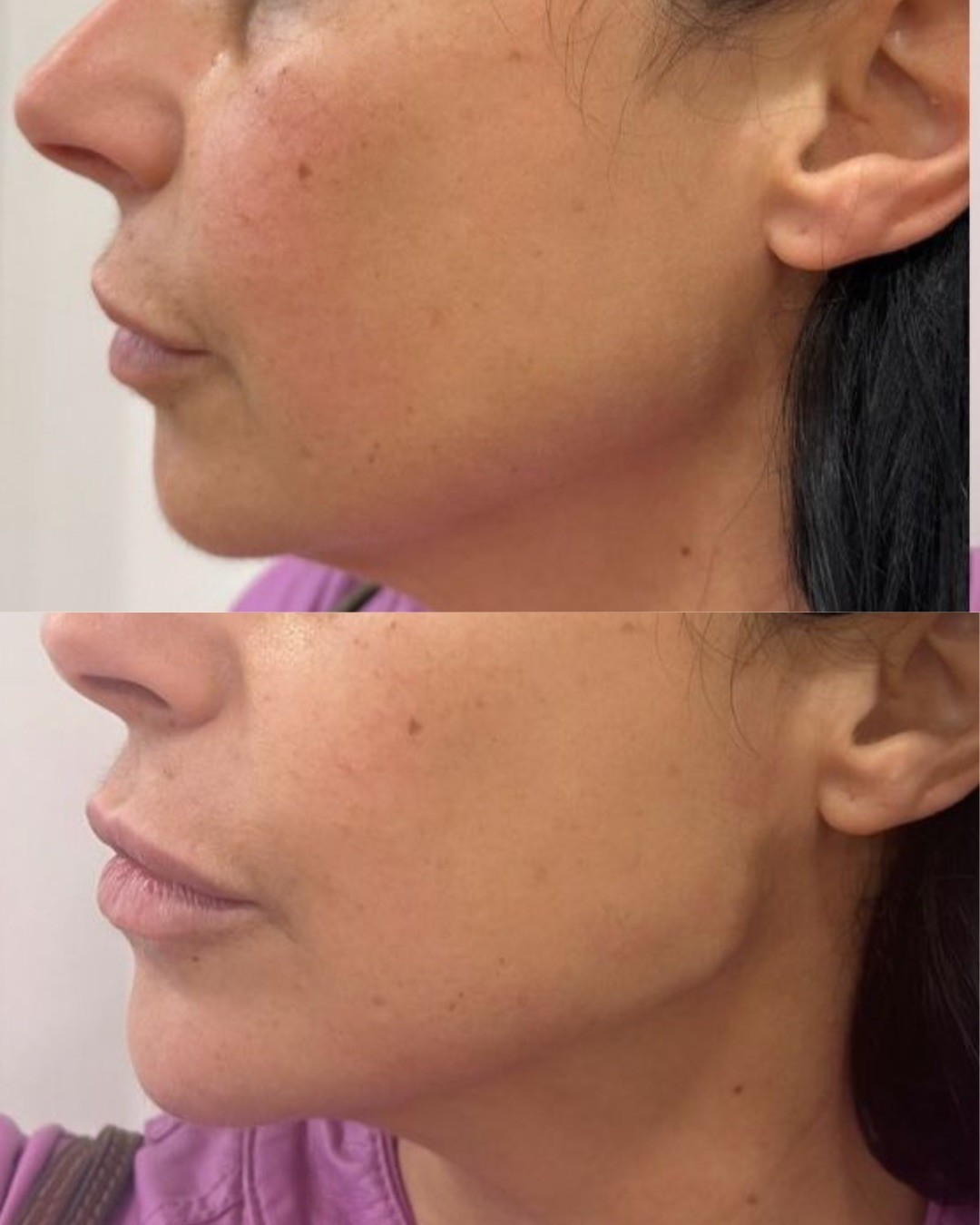
Nasolabial fold filler improves the appearance of the fold at rest. It does not eliminate the crease entirely in advanced cases, and it does not change what happens in expression — when smiling, the fold deepens because that is how anatomy works. Anyone expecting their face in expression to look "like it did at 25" will leave the consultation disappointed, regardless of product or practitioner.
The clinical goal is to soften, not erase. A well-executed result is not detectable as "filler" — it reads as a rested face with good volume. When someone comments that you look fresher without being able to say why, the treatment has done its job.
Overfilling is a common mistake in clinics that lack criteria. It produces a "too-full face" appearance — overly prominent cheeks and a result that reads clearly as aesthetic intervention. The quantity used should be conservative in the first session, with a review at two weeks.
We always use less product than the anatomy would "allow" in the first session. It is easier to add than to correct excess.
Who is a good candidate
Nasolabial fold filler works best in:
- Moderate folds visible at rest but without marked skin excess
- Patients with good skin thickness (not very thin skin)
- People whose fold deepening is primarily caused by midface volume loss
- First-time treatments where a conservative session allows assessment of individual response
It is less indicated — or should be combined with other approaches — in very deep folds with skin excess, in very thin skin where product may create visible irregularities, and in cases where generalised midface laxity is the dominant issue.
These distinctions need to be made during a consultation, not in an article. Every face has specific anatomy that a clinical assessment can read in ways that a photograph or questionnaire cannot reproduce.